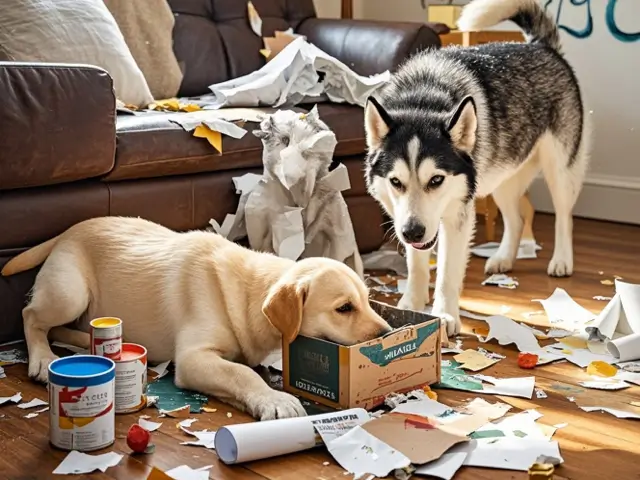
1. Why do puppies like chewing on things randomly?
After weaning, around one month old, puppies are in the teething period, which causes itching. When they reach four to five months old, they will also experience itching due to teething. During these periods, they will chew on things to relieve the itching. Generally, they will stop random chewing when they become adults. If they still chew randomly as adults, it may be due to personality or psychological factors, such as being bored at home to pass the time, lacking a sense of security, and so on.
2. Why can’t puppies eat salty food?
Feeding dogs too much salty food will not only damage their fur but also lead to kidney and heart problems, and may also cause tear stains. It is recommended that dogs eat professional dog food. Human food is too salty for dogs and should not be fed to them.
3. How many meals a day should a puppy eat?
Generally speaking, for young pets, they should be fed small meals frequently, 3 to 5 times a day. As they grow older to 5 to 6 months old, the number of meals can be reduced to 2 to 3 times a day. After 12 months old, it can be reduced to 2 times a day.
4. Why do puppies shed hair?
When puppies are 3 to 4 months old, their puppy fur will be replaced by permanent fur, and they will shed a lot of hair during this period. In addition, they will also shed hair during seasonal molting, such as changing from long hair to short hair in spring when summer is approaching. When autumn turns to winter, short hair will be replaced by long hair, but the shedding is not obvious. If there is patchy hair loss accompanied by a lot of dandruff or abnormal skin, it may be a skin disease.
5. My puppy often vomits but is in good spirits. What’s wrong?
Humans stand on two feet, so their digestive tracts are perpendicular to the ground. With the pull of gravity, humans rarely vomit. However, dogs and cats walk on four feet, and their digestive tracts are arranged parallel to the ground, so the effect of gravity is very small. In addition, the stomach is very close to the rectum. Vomiting can be caused by not defecating, constipation, improper food, chronic gastritis, etc.
But if the puppy is in poor spirits, vomits constantly, and has other symptoms, it must be taken to see a doctor. Some small dogs secrete gastric acid when hungry in the early morning, which can also cause nausea and vomiting of acid. At this time, you must adjust their feeding time immediately to avoid long-term corrosion of the stomach and esophagus by gastric acid, which may lead to upper digestive tract problems.
6. Why do puppies like chasing shoes?
This is a dog’s nature and a bad habit that needs to be corrected. Dogs are natural hunters and like to chase moving prey. They not only chase moving shoes but also other things such as other dogs, cats, birds, flies, cockroaches, etc. It can be corrected through a combination of rewards and punishments.
7. Why does my puppy smell bad?
A dog’s bad smell mainly comes from four parts: the mouth, ears, skin, and anus. Periodontal disease and tartar in the mouth can easily cause bad breath, and stomach discomfort can also lead to bad breath. Ear inflammation and ear mites can cause a bad smell. Skin diseases can also cause a bad smell. The biggest source of bad smell, however, is the anal glands on both sides of the anus, which are often filled with secretions that are squeezed out during defecation. The anal glands need to be cleaned regularly.
8. How should I bathe dogs and cats?
The ear canals of dogs and cats are “L”-shaped. Before bathing, you can roll a piece of cotton and plug it in the ear canal, then apply oily eye ointment or eye drops to both eyes to prevent water from entering. After squeezing the anal glands clean, you can bathe the whole body. Whether it’s cold or warm, it’s best to use warm water. Remember to rinse the body wash thoroughly, then dry and blow dry the fur to prevent colds or skin diseases.
9. Is it okay to bathe my puppy every two or three days?
There are sebaceous glands on a dog’s skin that secrete sebum, forming a sebum layer on the skin surface to protect the skin. Frequent bathing will damage the sebum layer, eventually reducing the skin’s resistance, leading to infection and lesions. Generally, puppies can be bathed once a week, and large dogs once every two weeks.
10. Why do dogs like scratching?
Occasional scratching is a dog’s way of self-cleaning. If the scratching is severe, you need to worry about whether there are parasites or skin diseases. For some long-haired dogs, if the owner does not comb their fur well, it will cause tangles. At this time, pulling the skin will cause pain and itching, and the dog will keep biting, making the hairball bigger and bigger.